Introducing the Integrated Behaviour Change Wheel

The Integrated Model of Behaviour is now being used in a range of projects and is proving its mettle in terms of facilitating the identification of a range of barriers and facilitators along the whole behavioural pathway that would be very difficult to do using any of the other established behaviour change models. This is because the integrated model nests the most established current models within an integrated framework and extends them into areas that don’t appear in any current approach.
This is not to say that researchers using COM-B, for example, do not consider choice, but choice does not explicitly appear in the framework, so it’s not highlighted as an issue and the framework doesn’t provide any systematic way of analysing choice. Similarly, those using a rational choice approach may consider the factors that influence people’s preferences, but it doesn’t provide any systematic way of exploring or identifying those drivers, so any consideration of them is likely to be ad hoc.
In addition, there are a number of important elements of the Integrated Model that don’t appear in existing approaches. For example, none of the frameworks distinguish between the ‘behaviour’ and the ‘impact’ of the behaviour, something that is crucial when working with goal-driven animals such as people. For example, the COM-B model has arrows that lead directly from motivation to behaviour, and then feedback arrows from behaviour to capability, opportunity and motivation, but there’s no arrow leading from behaviour forwards to the impact of the behaviour. Given how important impacts are on whether people will undertake a given behaviour or repeat it, it’s hard to believe that this distinction hasn’t been formally recognised in any of the established behavioural models. It is particularly important when the behaviour in question requires substantial effort to implement. Who would stick to a diet if they weren’t losing weight?
But while the Integrated Model aims to move beyond existing frameworks in important ways, it doesn’t seek to throw the baby out with the bath water but instead draw on the best of the current approaches. One of the most successful aspects of the COM-B approach is the Behaviour Change Wheel, a diagrammatic representation of the different elements of COM-B and the types of intervention that in general are likely to be effective given different kinds of barriers.
We have therefore developed a version that reflects the whole of the behavioural pathway rather than just part of it, which we call the Integrated Behaviour Change Wheel (see below).
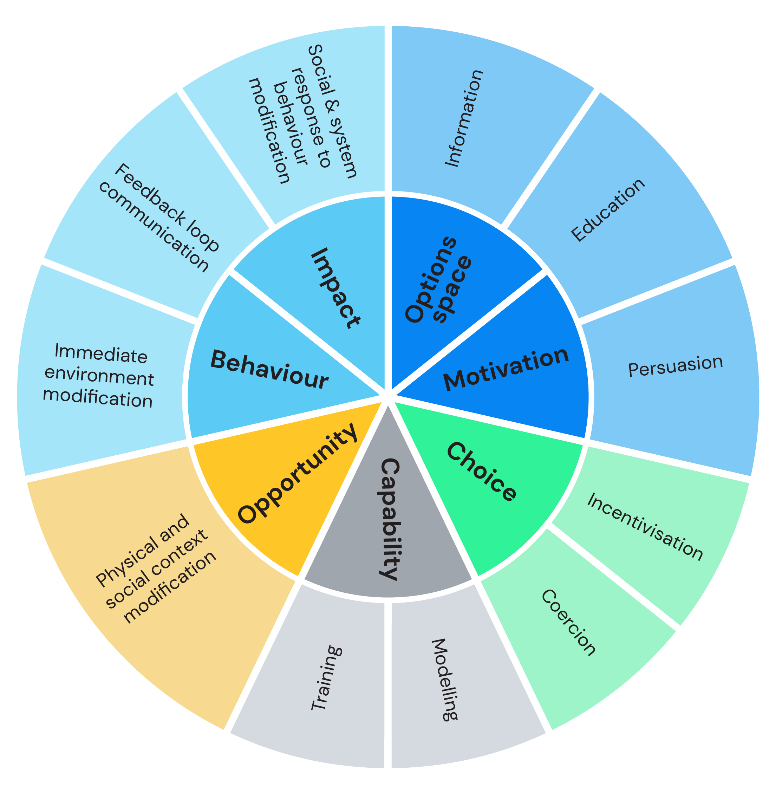
Starting from the options space (the set of objective and subject behaviours that people consider available to them) on the inner part of the wheel, interventions that can influence barriers in this part of the pathway include information provision and its stronger partner education. These would be directed at extending someone’s subjective options space so that it includes behaviours that exist within the wider objective options space but which they hadn’t previously considered. Education can also be effective in addressing motivational barriers, though sometimes education is not sufficient and interventions may need to persuade individuals. In other words, not simply providing them with the information and knowledge to allow them to make up their own minds but instead deliberately aiming to influence them cognitively and emotionally in favour of a particular decision. Obviously, much advertising spend has this intention, with companies such as Coke and Apple being masters in the art of persuasion.
Within the Integrated Model, choice is distinguished from motivation using the rational choice theory concepts of a ‘utility function’ vs a ‘budget line’. The utility function reflects how people value different goods or behaviours in relation to each other. The budget line is the reality of how much of a product someone is able to buy or the time and effort they have available that can be distributed between various behaviours. Choice is the outcome between the interaction between someone’s utility function and their budget line (representing the combination of behaviours and actions that achieves their highest possible utility given their budget). Choice interventions are conceived of as those which influence the budget line but are not intended to influence the utility function. The interventions in this area are the traditional levers used by government, including providing incentives in the form of subsidies and coercion to make a behaviour more costly due to fines or other adverse consequences such as incarceration.
In reality, these interventions might have more subtle impacts as well. For example, making something illegal and punishable by fines or imprisonment might signal that it is socially undesirable behaviour and for some people this may change their underlying feelings about it (their utility function/ motivation) rather than simply altering the costs involved. (This is a reminder that all models are simplifications and that reality is always more complex than any framework indicates. The trade off is that the model helps distinguish between noise and signal and therefore helps people make more effective decisions.)
Capability barriers are generally addressed by interventions such as training (aiming to directly improve the ability of individuals to carry out a behaviour) or modelling, a more subtle way of influencing an individual’s capability or perceived capability. Opportunity barriers are addressed by modifying the environment within which an individual is attempting to carry out a behaviour. This can be controversial, especially within government policy circles, as it often shifts the burden away from the individual and onto government, which can have substantial implications for the exchequer. But the simple fact is that it is much easier to go to the gym, say, if there is one within easy reach or to buy healthy food if your local shops sell it.
Interventions aimed addressing behaviour, impact and feedback barriers similarly can have negative implications as far as government and other bodies are concerned. Some of the appropriate interventions offer the hope of being low cost and providing quick wins, for example through bio-feedback mechanisms. However, other interventions may be less palatable as they imply that the government or an organisation has to change themselves in order to get individuals to change. For example, they may need to change the immediate environment to make carrying out the behaviour less aversive. An example of this is women-only gym sessions, because some women can feel uncomfortable or are made to feel uncomfortable training with men present. Another example is changing the actual response to a particular behaviour. For example, if you want people to engage more in consultation events, you may have to listen to what they say and act on it. Not all consultation events are run on the basis that the consultation is meant to influence the outcome, so this can be a substantial change in the way an organisation operates.
As with the original Behaviour Change Wheel, the Integrated Behaviour Change Wheel is a relatively high-level guide, but we hope it provides support in making strategic decisions when trying to identify appropriate interventions. These will then need to be followed up with much more detailed investigation into the specific interventions to be used, including understanding the theory and evidence that support them.